
Best Flight Controller for FPV Drone: F4 vs F7 vs H7 Compared
Posted by Roman on 9th Oct 2026
How to Choose the Best Flight Controller for an FPV Drone: F4 vs F7 vs H7
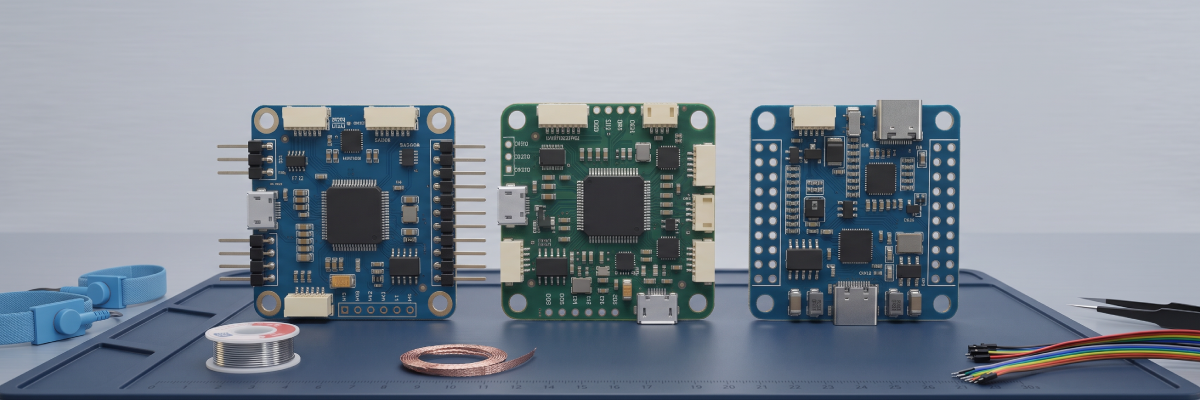
When you're picking the best flight controller for an FPV drone, the label on the box usually says F4, F7, or H7 before anything else — and that letter is often the least useful thing on the page. Buyers compare processor generation first because it's the easiest spec to read, not because it decides how a build flies. This guide explains how to choose a flight controller for your drone through the four specifications that actually matter: processor, gyro, UART count, and mounting size. It's written for someone speccing a quadcopter build, not debugging firmware.
What Does a Flight Controller Do in an FPV Drone?
A flight controller reads the gyro, compares it to your stick input, and sends correction signals to the ESC hundreds of times per second—that loop keeps a quad stable in the air. It also works as the hub that the receiver, VTX, camera, and often GPS connect through. The OSD provides overlay information such as voltage readings and timers on top of the video feed, while the firmware, usually Betaflight, turns this hardware into actual flight behavior. The bottom line is that boards alone don't necessarily make your drone fly better, but the wrong one will limit what you can run onboard and how much you can tune. Browse the current FPV drones lineup for reference points.
F4 vs F7 vs H7 Flight Controller Comparison: What the Processor Actually Changes
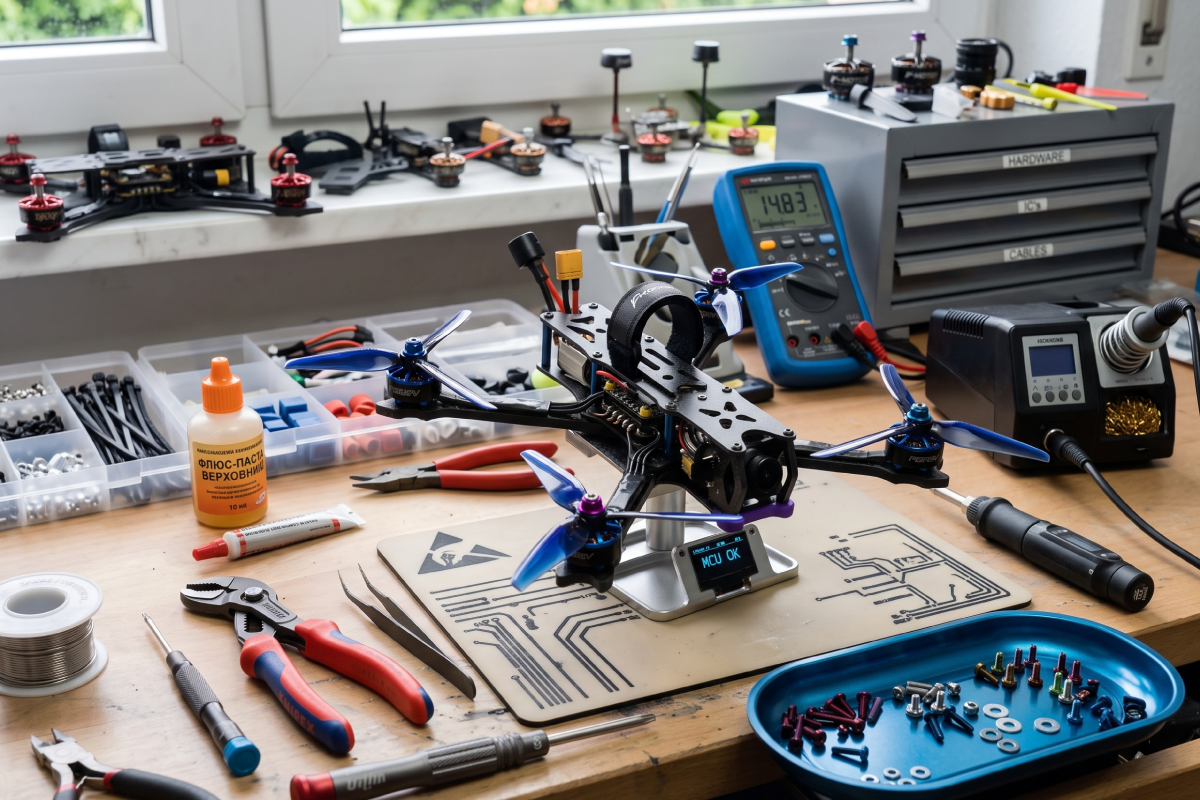
The processor generation is the spec most builds compare first, so here's what each one actually buys you.
|
F4 |
F7 |
H7 |
|
|
Clock speed |
168 MHz |
216 MHz |
400–480 MHz |
|
Typical UART count |
3–6 |
5–8 |
8+ |
|
SBUS inversion |
Software or pad-dependent |
Hardware on any UART |
Hardware on any UART |
|
Processing headroom |
Enough for a standard build |
Comfortable |
Large surplus |
|
Blackbox logging |
Onboard flash |
Onboard flash or SD |
SD card common |
|
Price level |
Lowest |
Middle |
Highest |
|
Best suited to |
Simple builds, small quads |
Most 5-inch builds |
Loaded builds, many peripherals |
On a standard 5-inch quad, an F4 board with a good gyro flies indistinguishably from an H7 board — the F4 vs F7 flight controller gap shows up in ports and headroom, not in how the quad feels. The processor only becomes the deciding factor once a build runs heavy filtering or several peripherals at once. Some of the smallest F4 boards are also increasingly limited by flash size, and a few newer firmware features are no longer available.
Is an H7 Flight Controller Worth the Money?
Whether it's worth it depends on how loaded the build is. An H7 earns its price when a quad carries GPS, a digital video system, LEDs, and telemetry at once and would run out of ports on anything smaller — it's also worth it for anyone who wants every filtering option turned on without watching CPU load. It's not worth it for a first 5-inch freestyle build, a racing quad, or anything running two or three peripherals. The H7 vs F7 flight controller decision for racing comes down to weight, reliability, and a clean gyro, not clock speed. A better use of that budget is often a cleaner gyro or a stronger ESC, not a faster MCU.
The Gyro Matters More Than the Processor
Whichever side of the F7 vs F4 flight controller debate you land on, the gyro — or IMU — is the sensor the whole tune is built on, and a faster MCU can't fix a noisy gyro. The MPU6000 is an older sensor but remains a reference point for clean, low-noise output. Newer options like the ICM-42688-P run at higher sample rates and handle vibration better, while the BMI270 is now common on budget boards and performs well on current firmware. Soft-mounted gyros, rubber grommets, and the board's own vibration isolation affect the result as much as the sensor itself. Check which gyro a board uses before comparing processor generations.
UART Count: The Spec That Actually Limits Your Build
Every device that sends or receives data—receiver, VTX, GPS, ESC telemetry—occupies one UART, and this spec quietly limits a build more than processor choice ever does. A typical loaded quad uses one UART for the receiver, one for the VTX, one for GPS, and one for ESC telemetry. A board advertised with six UARTs may offer fewer in practice, since some are already assigned to onboard peripherals. Running out of free ports mid-build is one of the most common reasons a project gets re-planned. Rule of thumb: count your peripherals, add one spare, and buy a board with at least that many free UARTs.
Mounting Size: 30.5×30.5, 20×20 and 16×16
A board with the right processor and gyro is still unusable if the mounting holes don't match the frame.
|
Mounting pattern |
Screw size |
Typical build |
|
30.5 × 30.5 mm |
M3 |
5-inch and larger |
|
25.5 × 25.5 mm |
M2 |
3-inch to 4-inch |
|
20 × 20 mm |
M2 |
Toothpicks, 2-inch to 3-inch |
|
16 × 16 mm |
M2 |
Tiny whoops, 1S and 2S |
The flight controller and 4-in-1 ESC need to share the same mounting pattern to bolt together into a stack, and you should check frame stack height before ordering either board. Browsing the drone store lets you filter boards by mounting size directly.
Flight Controller Stack or AIO Board: Which Format Suits Your Build
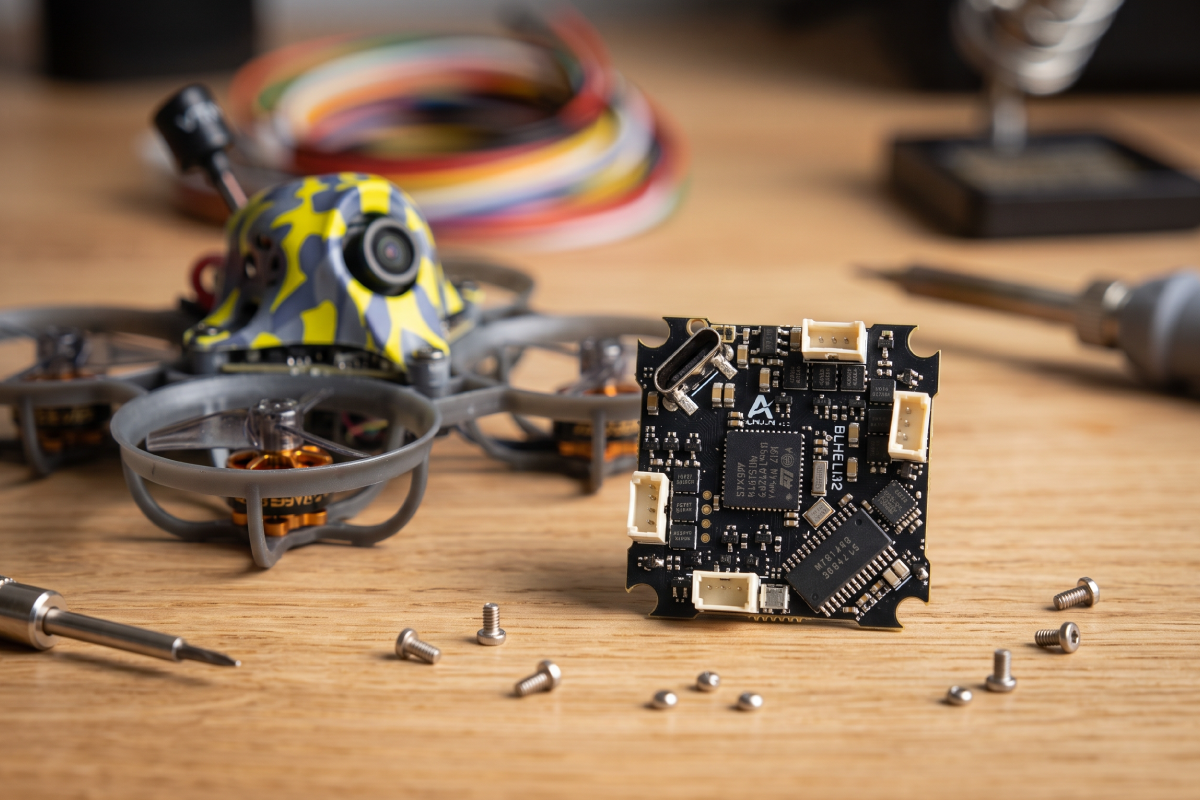
A flight controller stack is a separate flight controller and ESC bolted together and joined by a ribbon cable. An AIO board puts both on a single PCB, sometimes with the receiver and VTX built in too. Stacks are easier to repair, since a burnt ESC doesn't mean replacing the flight controller as well. AIO boards save weight and build time, which is why they dominate small quads. For a 5-inch build, a flight controller stack is usually the better long-term choice; for anything under 3 inches, an AIO board almost always wins instead. Browse the current flight controllers selection to compare stack and AIO options side by side.
Features to Check Before You Buy the Best FPV Flight Controller
Beyond the headline specs, a few smaller features decide how much you'll enjoy actually using the board:
- BEC output rails and current rating — the 9V rail has to carry the VTX without sagging.
- Built-in OSD — most modern boards include it; some budget ones skip it.
- Blackbox logging, onboard flash or SD card — flash fills up fast on longer flights.
- A barometer — needed for altitude hold and GPS rescue.
- USB-C rather than micro-USB — a connector that survives repeated use.
- The ESC connector type, and whether a matching cable is included.
- Soft-mounting hardware included, not sold separately.
- A firmware target still supported in current Betaflight releases — an unsupported board stops getting fixes.
Pair whichever board you land on with brushless motors rated for the current that the ESC can actually deliver.
How to Choose a Flight Controller for Your Quadcopter Build
Which flight controller for your quadcopter build comes down to matching frame size, peripherals, and budget — not chasing the newest processor generation:
- First 5-inch freestyle build → 30.5 × 30.5 stack, F4 or F7, a good gyro, four free UARTs.
- Racing quad → F7, light, minimal peripherals — the best flight controller for FPV racing favors weight and reliability over speed.
- Long-range build with GPS → F7 or H7, a barometer, plenty of free UARTs.
- Cinematic build with digital video → H7, for the port count and headroom.
- 3-inch or toothpick → 20 × 20 AIO board.
- Tiny whoop → 16 × 16 AIO, receiver usually built in.
- Rebuilding after a crash → match the mounting pattern and connector first, then compare specs.
Start with the frame and peripherals list, then pick the board that meets both—that's the best FPV drone flight controller for your build, regardless of what the box says about the processor.
Frequently Asked Questions About Choosing a Flight Controller for an FPV Drone
What is the difference between an F4 and an F7 flight controller?
The F7 runs at a higher clock speed, usually offers more UARTs, and handles SBUS inversion in hardware on any port. On a standard 5-inch quad, the difference in flight is not noticeable — F7 mainly buys port count and headroom.
Is an H7 flight controller better than an F7?
Better on paper, and useful on a build with GPS, digital video, and telemetry running at once. On a simple build, it's spare capacity you never use. Choose it for port count and headroom, not because it flies better.
How many UARTs does an FPV drone need?
Most builds need three to four: receiver, VTX, ESC telemetry, and GPS. A minimal build with an analog VTX and no GPS can manage with two. A board with one spare UART avoids re-planning later.
Which gyro should I look for?
The MPU6000 remains a benchmark for clean output. The ICM-42688-P and BMI270 are the current alternatives, and both perform well on modern firmware. Mounting and vibration isolation matter as much as the sensor part number.
What size flight controller does a 5-inch drone use?
The 30.5 × 30.5 mm pattern with M3 screws is the standard for 5-inch frames. The flight controller and the 4-in-1 ESC must share the pattern to stack together.
Can any flight controller be used with any ESC?
Almost always, as long as the mounting pattern and connector type match and the ESC is rated for the battery voltage the build uses.